
Review Papers
Review on multi-material AM from a computational design perspective
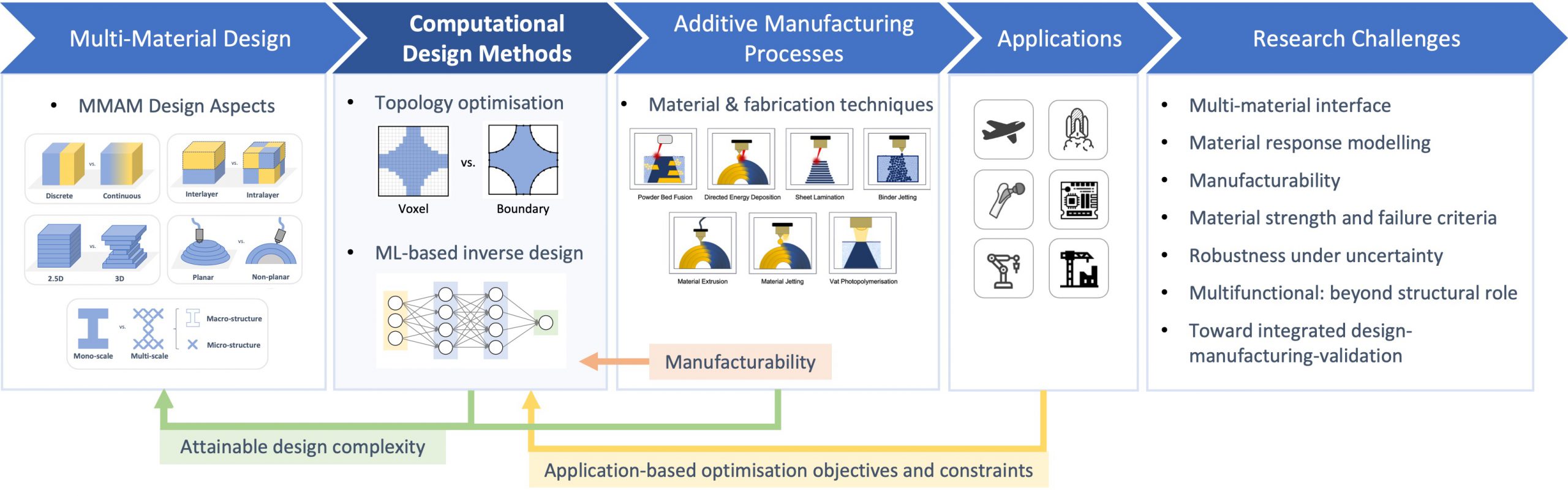
- This review provides a comprehensive evaluation of computational algorithms available for multi-material design, encompassing numerical methods like topology optimisation as well as data-driven inverse design strategies.
- MMAM techniques are evaluated for their multi-material design capability and manufacturing constraints.
- Key challenges in MMAM design are identified, including multi-material interface, advanced material response modelling, manufacturability, failure constraints, robustness, multifunctionality, and integrated design-manufacturing-validation workflow.
- Future research directions are also suggested to pave the way for innovative multi-material applications.
Review on design and structural optimisation
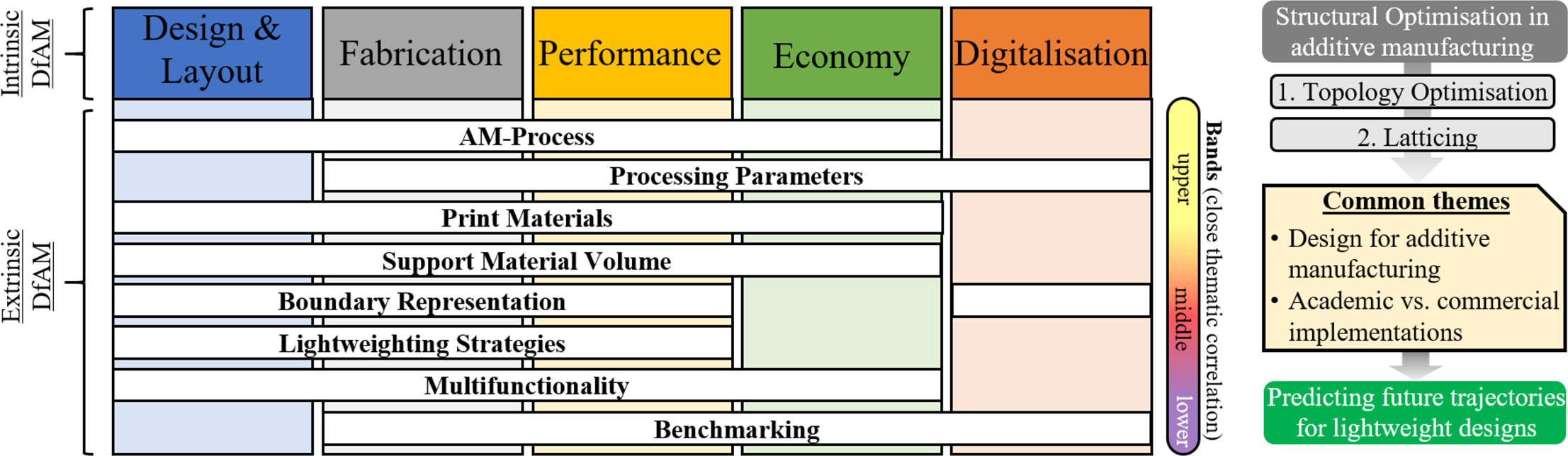
As the application of additive manufacturing (AM) reaches an unprecedented scale in both academia and industry, a reflection upon the state-of-the-art developments in the design for additive manufacturing (DfAM) and structural optimisation, becomes vital for successfully shaping the future AM-landscape.
A framework, highlighting both the interdependencies between these two central aspects in AM and the necessity for a holistic approach to structural optimization, using lightweight strategies such as topology optimization and/or latticing, was established to summarize the reviewed content. Primarily focusing on isotropic material considerations and basic stiffness-optimal problems, these concepts have already found wide application, bridging the gaps between design and manufacturing as well as academia and industry.
In pursuit of streamlining the AM-workflow towards digitally print-ready designs, studies are increasingly investigating mathematically-based structural optimization approaches in conjunction with DfAM-specific constraints, providing a portfolio of solutions like generative design, which is gaining traction in industry.
Besides an overview on economically-driven to performance-driven design optimizations, insight into commercial AM-specific software is provided, elucidating potentials and challenges for the community. Despite the abundance of AM design methods to-date, computationally inexpensive solutions for common engineering problems are still scarce, which is constituting one of many key challenges for the future.