
Data Driven Design
ML-based optimisation for FGMM
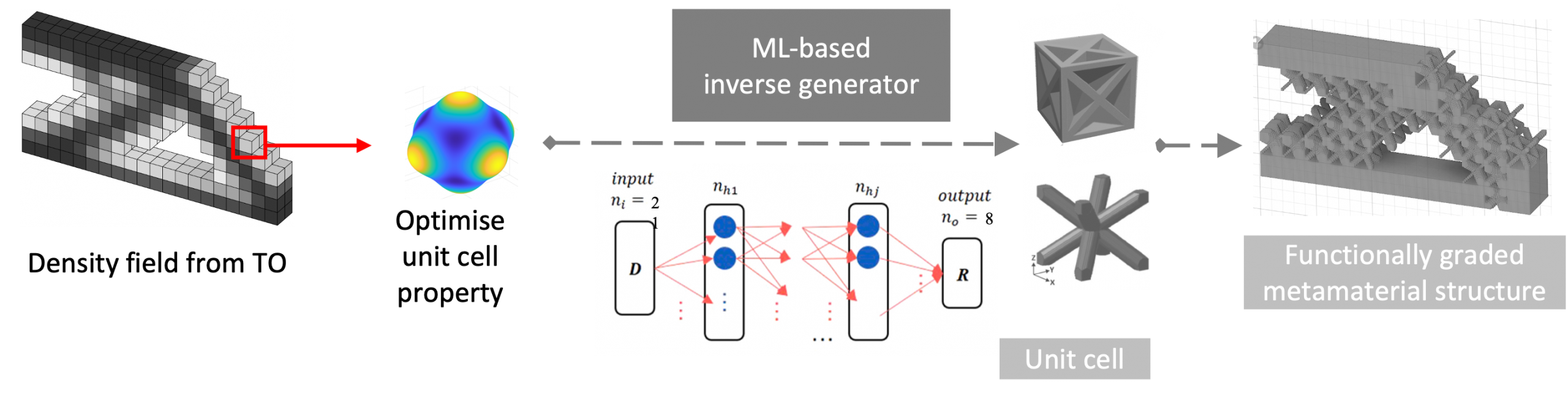
We have developed a Machine Learning (ML)-based framework for the generation of Functionally Graded Metamaterials (FGMMs) and graded lattice structures, integrating Topology Optimisation (TO) and neural network-based inverse design methods. In particular, a Neural Network (NN)-based inverse lattice generator is trained to predict lattice unit cell configurations directly from target mechanical properties, enabling rapid and automated material design. The framework further leverages low-resolution TO results to provide physics-guided priors, improving the consistency and manufacturability of the generated lattice mappings. The initial NN implementation demonstrates the feasibility of fast inverse design for lattice materials, while the incorporation of TO-informed guidance enhances accuracy and design robustness across heterogeneous property distributions. Overall, the proposed approach enables near-optimal lattice generation with significantly reduced computational cost, supporting rapid exploration and optimisation of graded metamaterial architectures for advanced engineering applications.

Benchmark
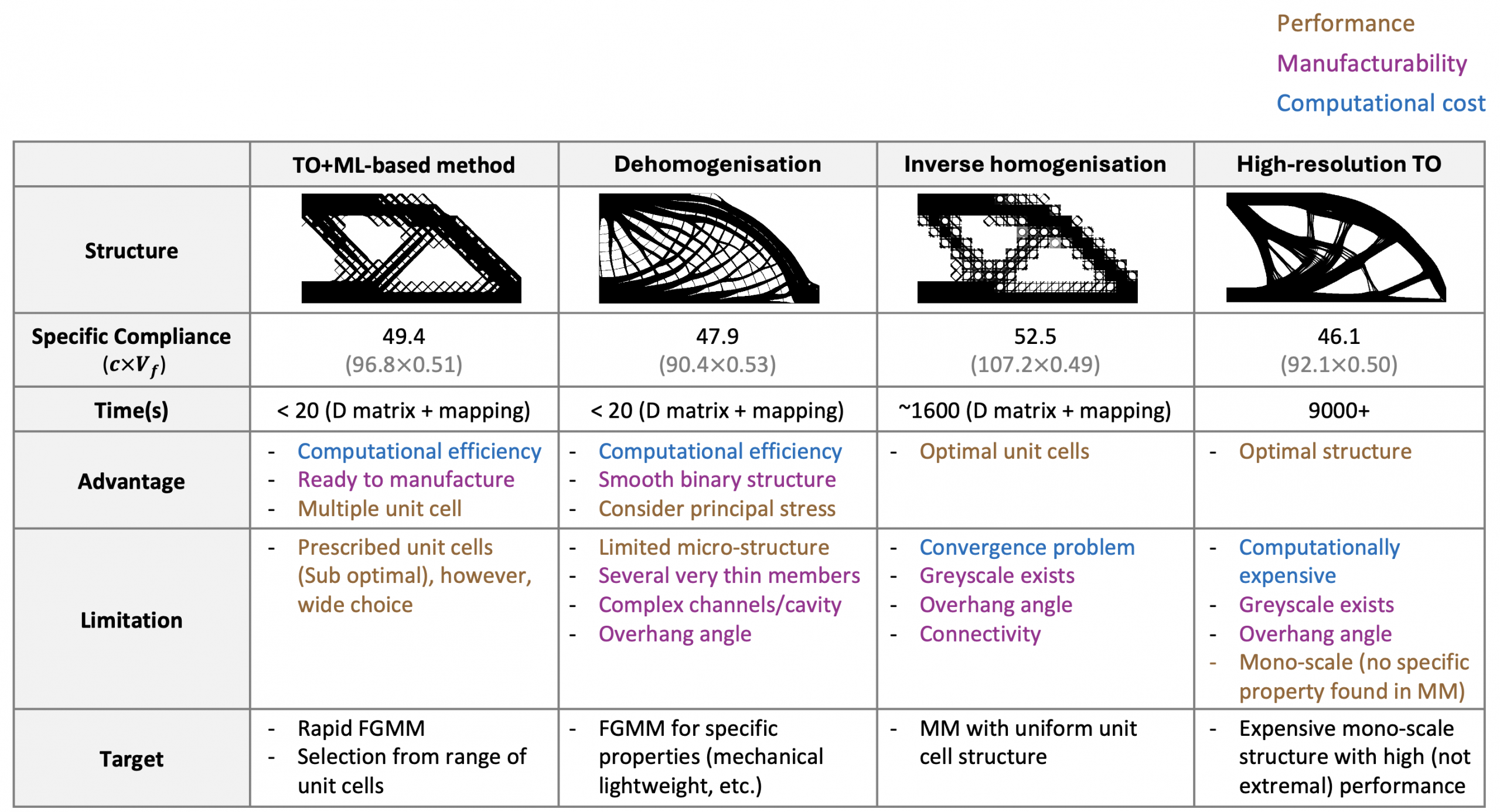
We conducted a benchmark of our lattice generation approach by comparing with other approaches; dehomogenisation and inverse homogenisation.
- Our approach has comparable optimal structure’s performance and the computational efficiency, compared to dehomogenisation.
- Ensure manufacturability of the obtained structure without overhang angle or grey scale region.
- Versatile for multiple manufacturable unit cells, opening possibility in wider application fields.
ML-based inverse design of lattices
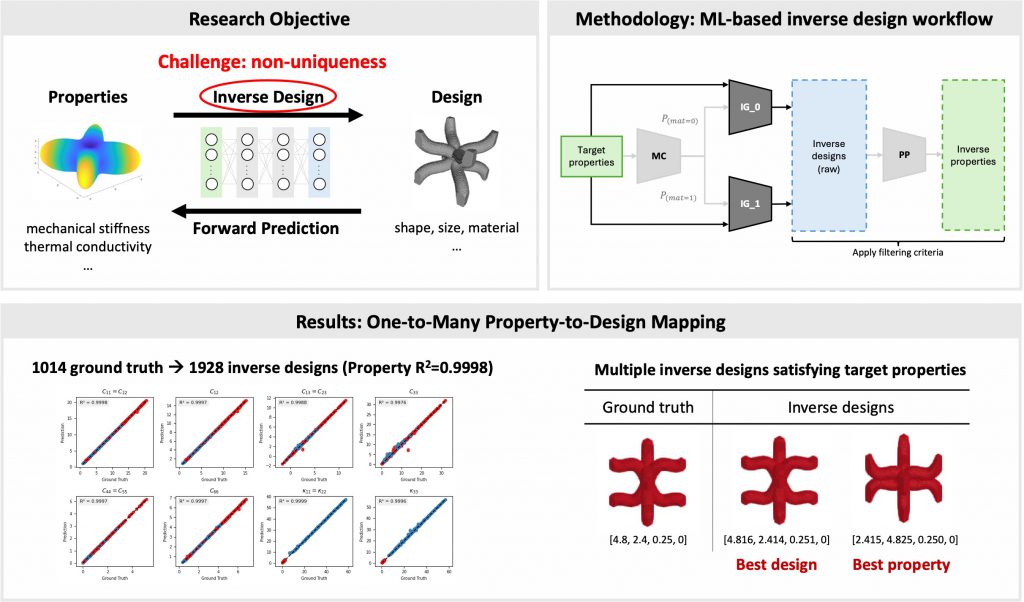
In this work, we proposed a ML-based inverse design framework to realise multi-material curved lattice structures, enabling the optimisation of multifunctional FGMs.
- The proposed unit cell design parameterisation enables simultaneous optimisation of shape, size and material, offering vast property space beyond conventional VF grading.
- High accuracy and efficiency in property prediction and inverse design by ML models, capable in handling mixed-type design features and properties across different physics.
- The MDN enables one-to-many inverse design, allowing further filtering based on manufacturability or other criteria.
Smooth transition unit cell
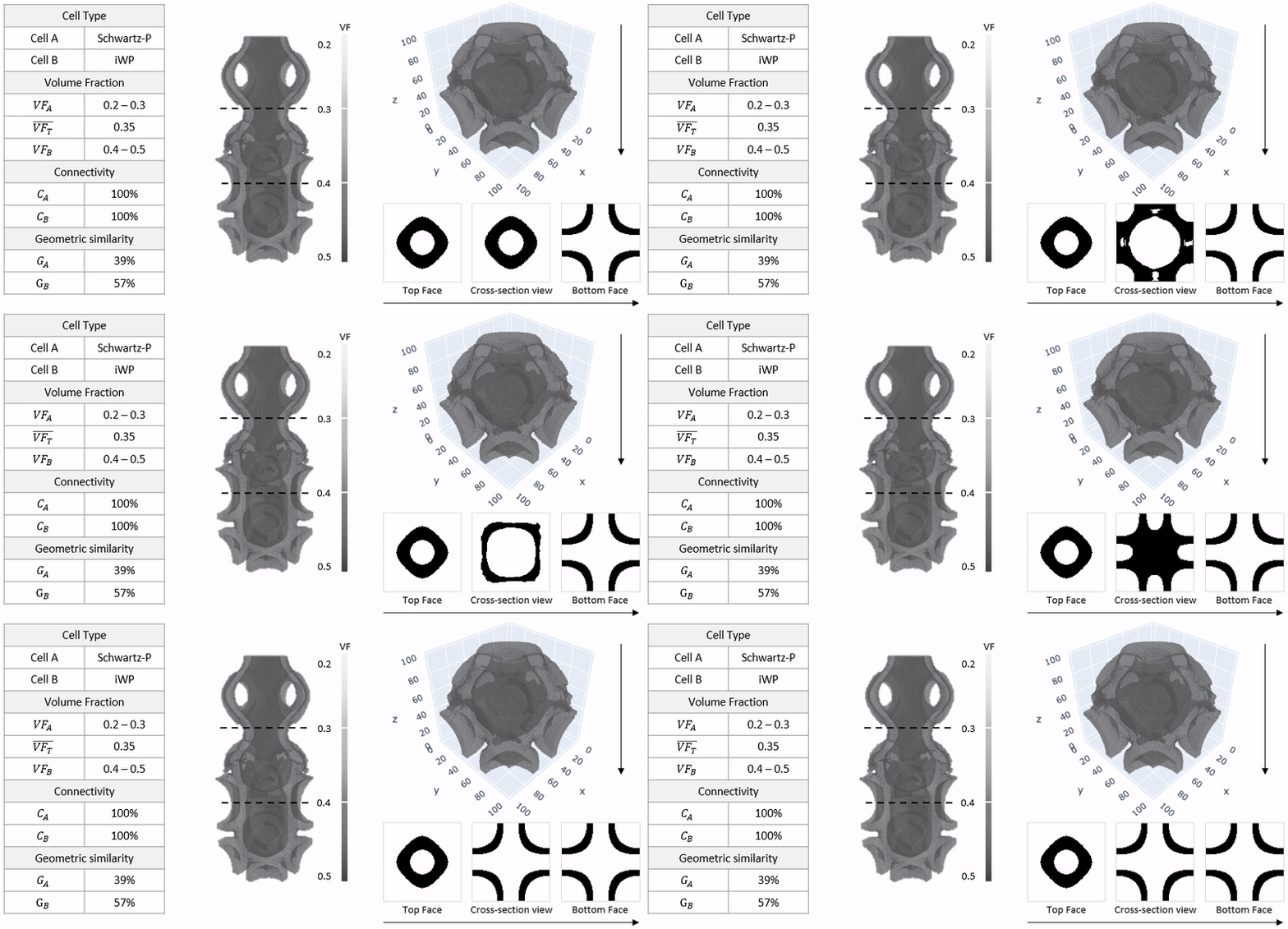
A latent-space-arithmetic-based framework is proposed and developed in this project to generate smooth transition between dissimilar unit cells. It allows lattice structures with multiple unit cell types to be realised. * Variational Autoencoder (VAE) is trained to map the unit cells to the latent space * The proposed strategy ensures both smoothness in transition and connectivity with the target cells. * Transitions between different types of triply periodic minimal surface (TPMS) and truss-based unit cells can be generated. Benchmark comparisons against analytical morphing and existing ML-based solutions indicate that the proposed framework consistently achieves superior performance.