
Additive Manufacturing
Lattices
Dynamic behaviour of functionally graded lattice structures with short carbon fibre reinforcement

This work systematically investigates the dynamic behaviour of composite and functionally graded lattice structures subjected to drop-weight impact. The following key objectives are addressed:
- Examine the combined influence of multiple design parameters, including relative density, material composition, and unit cell type, on dynamic response and energy absorption.
- Mitigate catastrophic failure and enhance impact energy absorption through functionally graded designs and the integration of short carbon fibre reinforcement.
- Extend quasi-static insights to dynamic regimes by characterising strain-rate sensitivity across the intermediate strain-rate range and varying impact energies, supported by plasticity model.
- This investigation provides critical insights into the dynamic failure response of additively manufactured lattice structures, highlighting how both design parameters and loading conditions influence mechanical performance. The focus on intermediate strain-rate regimes aligns with practical engineering applications requiring impact mitigation, such as sports equipment and tool-drop protection systems.
▼ Relevant Publication(s)
Dynamic compression of sinusoidal plate lattices: energy absorption and failure characteristics
This work introduces a sinusoidal geometric feature into plate lattice structures to alter failure mechanisms and compressive performance, supported by experimental investigations of both conventional and modified lattices.
- Failure in flat plates differs between BCC and FCC unit cell configurations, with behaviour supported by classical plate theory predictions.
- The sinusoidal modification suppresses localised failure, with its effect varying by unit cell configuration (e.g. BCC or FCC) due to differing failure modes.
- Quasi-static and dynamic testing reveals distinct strain-rate sensitivity between flat and sinusoidal variants, enabling mechanical behaviour to be tailored to specific application demands.
The novel sinusoidal design enables control over deformation and failure responses in plate-based lattices, with its effectiveness governed by the underlying failure mechanism and loading conditions.

The dynamic behaviour of functionally graded lattice structures with short fibre reinforcement
This study experimentally investigates the dynamic response of AM lattices under varied impact energy. The examined lattice parameters include unit cell topology, grading strategy (relative density and cell size grading), testing direction, and the integration of carbon fibres into the polymer-based material.
- The dynamic mechanical properties are influenced by the overall relative density and unit cell topology.
- Fibre-reinforced lattice structures exhibit greater energy absorption than pure polymer, with a 37.6% in the benchmark case.
- These experimental insights enrich the understanding of lattice dynamic behaviour and support the adoption of AM composite in crash protection applications.
▼ Relevant Publication(s)
Cold Spray
Custom-made Vacuum Cold Spray System for In-space Manufacturing and Repair
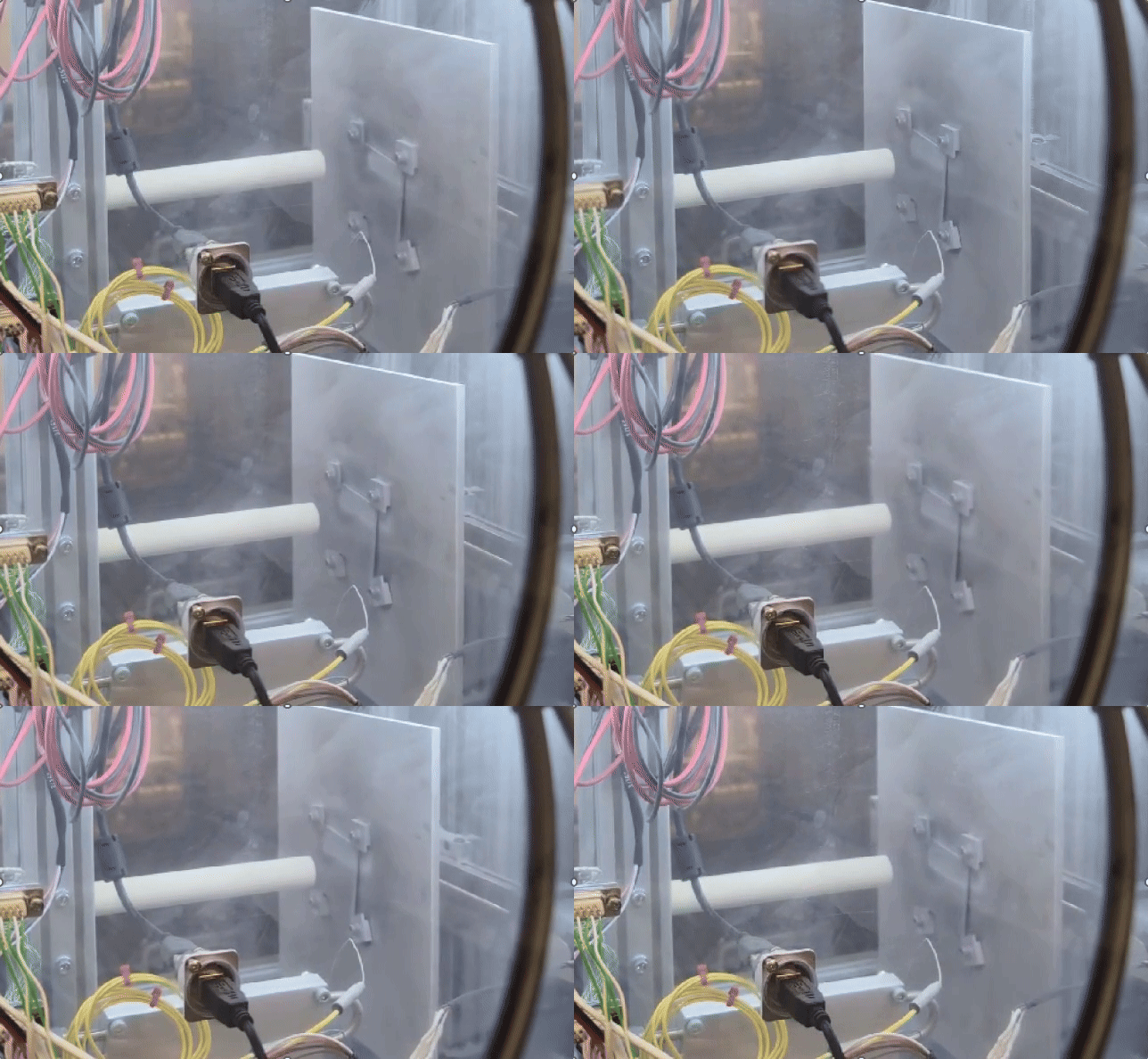
The COSMOS project combines cold spraying with vacuum technology or processes to developed custom-made cold spray system for use in space; to manufacture and repair spacecraft components, like the international space centre.
- To develop a cold spray system that operates under high vacuum conditions by combining techniques used in cold spray additive manufacturing and vacuum aerosol deposition processes.
- To design and build a comprehensive experimental setup that includes a cold spray nozzle and chamber set-up, and powder delivery system that can operate safely within the vacuum environment.
- To demonstrate successful deposition of titanium powder and its composites with the cold spray in vacuum set-up by conducting sensitivity study of spraying parameters to enable high quality prints or repair for in-space manufacturing and repair.