
Multi-Disciplinary Optimisation
Topology optimisation with engineering constraints
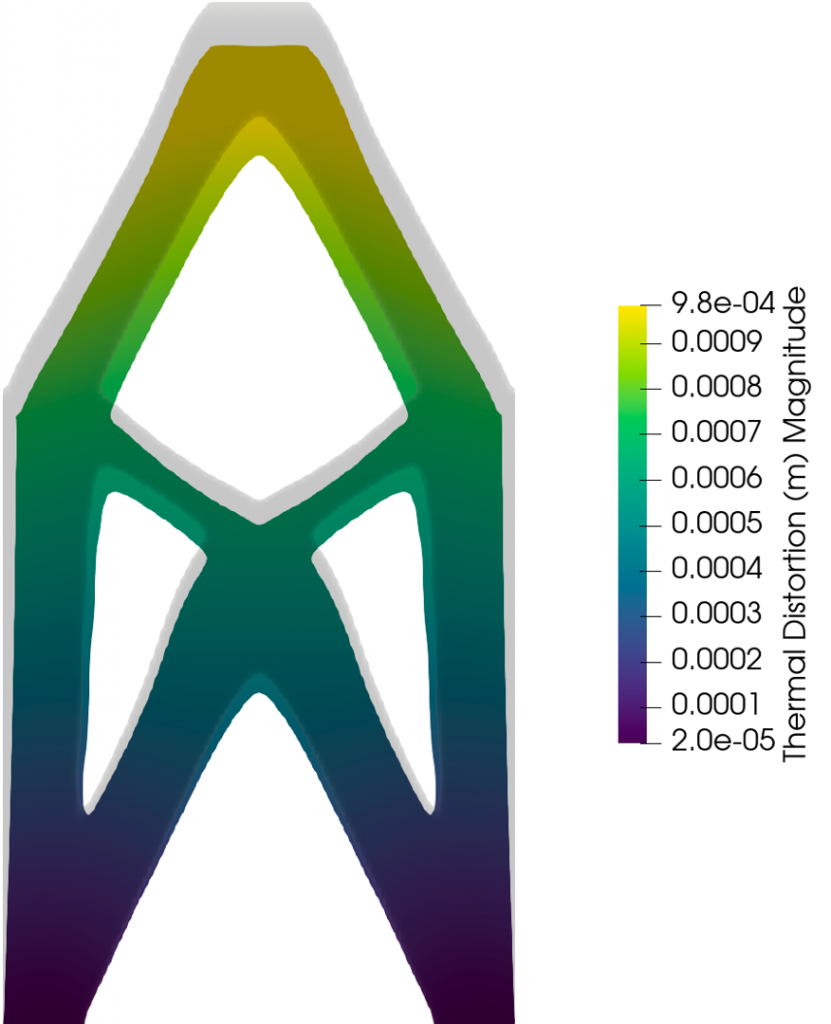
The objective of this project is to develop a right-first-time design methodology for complex engineering parts manufactured via laser wire direct energy deposition, ensuring compliance with mechanical and thermal stress constraints while minimising distortion caused by process-induced temperature gradients.
- Reduced Distortion: minimises process-induced temperature gradients through a combination of topology optimisation (density fields) and strategic deposition planning.
- High-Efficiency Modeling: using Firedrake to implement low-fidelity transient, adjoint-based thermo-mechanical simulations for rapid sensitivity analysis.
- Model Validation: coupled thermomechanical results are validated via in-situ monitoring and post-process testing of benchmark parts.
- Holistic Design: optimises for support structures, in-service loading, and line-of-sight constraints simultaneously.
Topology optimisation of implants
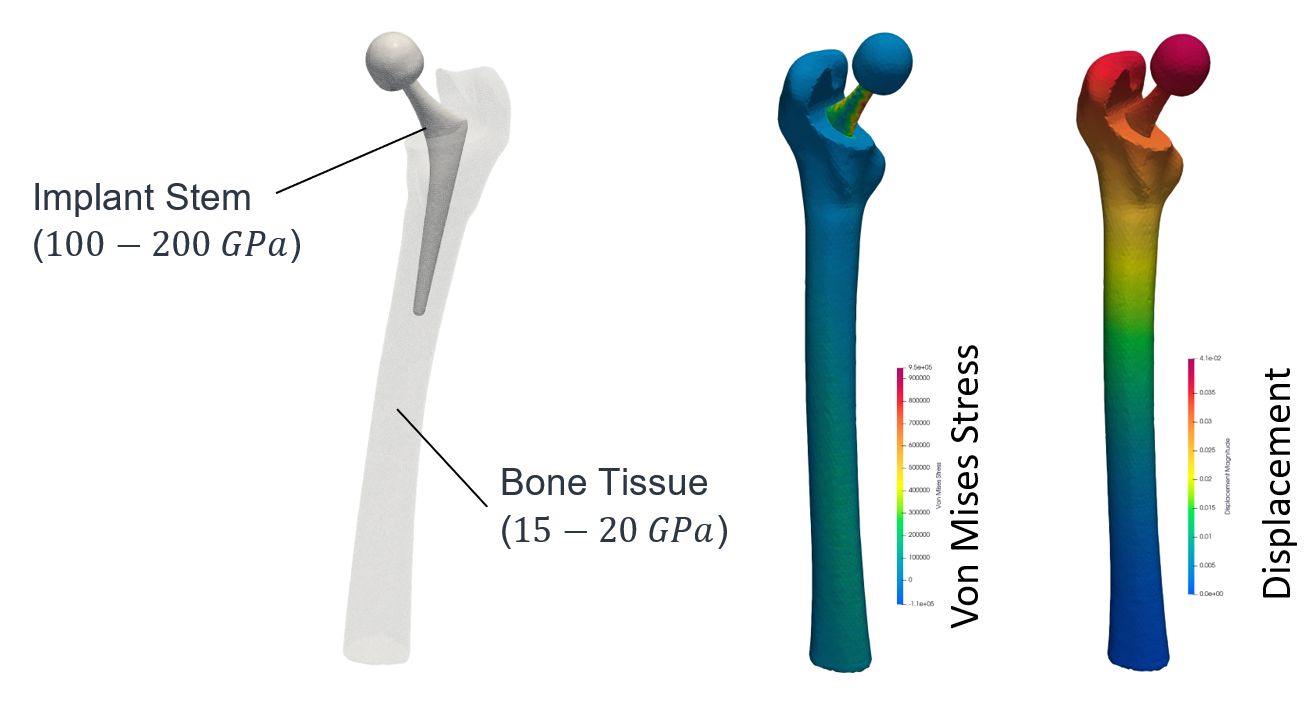
Total Hip Arthroplasty (THA) is a surgical procedure to replace damaged hip joints, but a significant challenge is the need for costly revision surgeries due to implant failures, costing the UK’s NHS over £60 million annually. The most common causes for revision are aseptic loosening and bone remodelling, both linked to inadequate implant design. This project aims to develop patient-specific implants using a multi-objective optimisation approach to minimize these risks by optimising implant topology.
The collaboration between Imperial College London and the University of Birmingham integrates computational design, additive manufacturing, and experimental testing to create and validate functionally graded implants, potentially improving post-THA outcomes.
- THA revision surgeries are costly and often caused by risks of aseptic loosening and bone remodelling.
- The project aims to design patient-specific implants to reduce these revision risks. A multi-objective optimisation framework is proposed to find optimal implant topologies.
- Complementing computational design approach with additive manufacturing and experimental validation to test the optimised implants.
▼ Relevant Publication(s)
Topology Optimisation of bespoke lattice orthopaedic implants (In preparation)
Design optimisation of battery housing
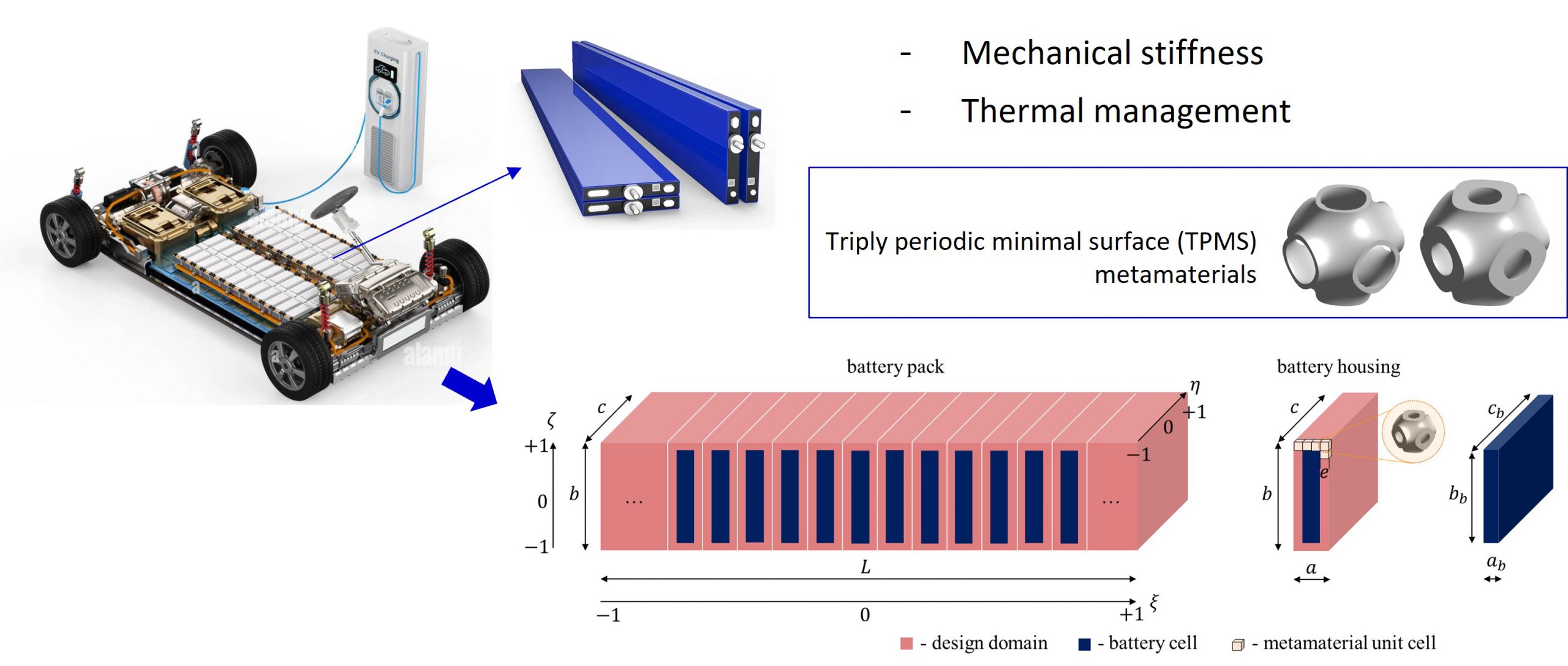
In this study, a graded lattice design framework is developed based on Topology Optimisation (TO) to effectively tackle the multidisciplinary objectives associated with battery housing.
- Leverages the triply periodic minimal surfaces lattices, aiming for high mechanical stiffness and efficient heat dissipation considering heat conduction and convection.
- Bridges the research gap by embedding thermal convection into the TO framework, while accounting for thermal conduction in thermal management.
- Demonstrated through the battery housing design, showcasing its ability to address multidisciplinary objectives as evidenced by the analysis of the Pareto front.